
· by Michael Blair, Nashville's Closets
In a tornado warning, a lot of Middle Tennessee families end up in the same place: the closet in the middle of the house. It is a reasonable instinct, and FEMA lists interior closets among the places a home safe room can be built. But a closet and a safe room are not the same thing, and a closet with boxes stacked on the high shelves is a poor place to sit through a storm. Here is what the federal guidance says, and how we lay out a walk-in closet that has to do both jobs.
Is a closet a safe place in a tornado?
An interior closet on the lowest floor, with no windows, is one of the better places in an ordinary house, but it is not protection in itself. The National Weather Service’s tornado safety guidance tells people under a warning to go to a basement, a safe room or an interior room away from windows. FEMA’s Taking Shelter from the Storm, its December 2024 guide to home safe rooms, is blunter: the safest area of a building does not guarantee your safety, and only a shelter built to ICC 500 or a safe room built to FEMA P-361 provides life-safety protection from a tornado.
So a closet can be one of two things. It can be the best room you have, made better by how it is organized, or it can be an engineered safe room that also holds clothes. Most of this post is about the first, because that is the closet most houses already have.
Can a closet be turned into a safe room?
Yes, but that is a structural project, not a closet project. FEMA’s guide names interior closets, along with bathrooms and small storage rooms, as rooms suited to double as safe rooms, since they usually have one door and no windows and earn their space the rest of the year. It also says a safe room inside a house has to resist the same wind pressures and flying debris as one standing alone outside, because the house around it may be blown away entirely.
That calls for walls and a roof designed for the job and kept structurally independent of the house, and a door tested, listed and labeled for wind pressure and debris impact. FEMA’s design plans say not to attach the safe room ceiling to the floor or ceiling above it, and any connection to the house has to be designed or analyzed by a registered design professional. That work belongs to a builder and an engineer; the shelving and the rods go in after it.
How should a closet you shelter in be organized?
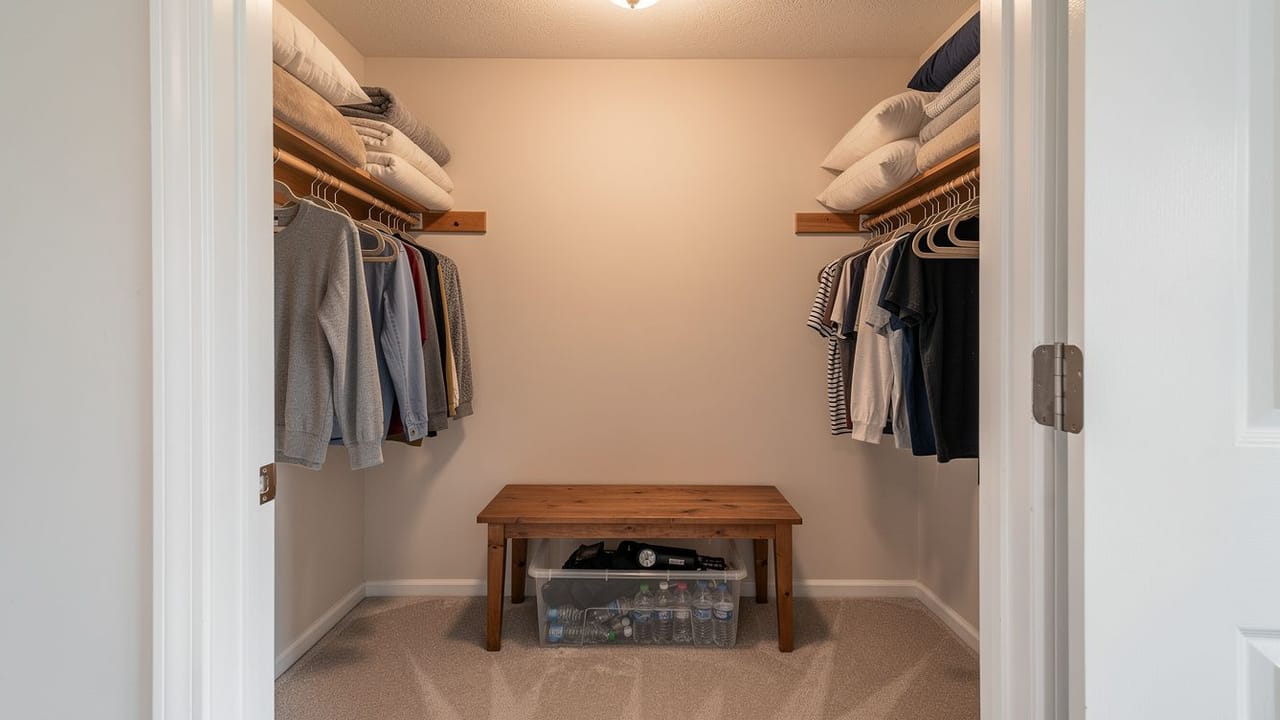
With a clear floor, nothing heavy overhead, and the supplies already inside. FEMA says a space used as a safe room should be kept free of clutter so people can get in quickly and are not hurt by falling objects, and the same reasoning holds for a closet that is simply the best room in the house. In practice the middle of the floor stays open, heavy bins and boxes go low or somewhere else, and the high shelves hold soft things such as blankets and pillows rather than luggage or tools.
Size it by the number of people. For a home tornado safe room, FEMA says at least 3 square feet of floor per person should be enough, since tornadoes pass quickly, and it notes that fixed fixtures and furnishings take away from the usable floor. A family of four needs about 12 square feet of open floor, which a center island or an armchair in a walk-in can quietly use up.
What to keep in a tornado closet
FEMA’s emergency supply list for a tornado safe room includes a gallon of water per person per day with a one-day supply, a day of food that needs no cooking, and a first aid kit, which it strongly recommends because people are often hurt rushing to shelter with little warning. It suggests keeping the kit in the safe room itself. In a closet we give that kit a fixed place at floor level near the door, where nobody has to reach up or dig for it in the dark.
Doing it ahead of the season makes sense here. The National Weather Service office in Nashville found in its Middle Tennessee tornado climatology that 66 percent of the region’s recorded tornadoes came in March, April and May, with activity rising again around November. We plan reach-in closets and walk-ins around Clarksville and the rest of Middle Tennessee with that clear floor in mind. Tell us which closet your family heads to, and we will lay it out for both jobs.
Sources
- FEMA P-320, Taking Shelter from the Storm: Building or Installing a Safe Room for Your Home (Sixth Edition, December 2024) — Life-safety protection only from ICC 500 shelters or FEMA P-361 safe rooms; closets as safe room locations; same wind and debris resistance inside a house; independent structure, tested door, design professional for connections; keep free of clutter; 3 square feet per person for tornadoes, 7 for hurricanes; emergency supply kit and first aid
- National Weather Service, Tornado Safety: During a Tornado — In a warning, go to a basement, safe room or interior room away from windows
- National Weather Service Nashville, Middle Tennessee Tornado Climatology — 66 percent of Middle Tennessee tornadoes in March through May; secondary peak centered around November
FAQ
Using a Closet as a Tornado Shelter at Home — questions
Are you safe in a closet during a tornado?
Safer than in most rooms, if it is an interior closet on the lowest floor with no windows, which fits the Weather Service’s advice to use an interior room away from windows. FEMA is clear that the safest spot in a house guarantees nothing; only a shelter built to ICC 500 or FEMA P-361 gives life-safety protection.
How do you turn a closet into a tornado safe room?
By rebuilding it as an engineered room. FEMA says a safe room inside a house must resist the same wind and debris as a freestanding one, with walls and roof independent of the house, a door tested and labeled for wind and impact, and any connection to the house designed or analyzed by a registered design professional.
How much floor space does a tornado shelter need per person?
For a home tornado safe room, FEMA says at least 3 square feet of floor per person should be enough, because tornadoes pass quickly; hurricane safe rooms need 7. Fixed furnishings reduce the usable floor, so a closet meant for four people needs about 12 square feet left clear, not counting shelves, benches or an island.
What should I keep in my tornado closet?
FEMA’s list for a tornado safe room includes a gallon of water per person for one day, a day of food that needs no cooking, and a first aid kit, since people are often hurt rushing to shelter. Keep it at floor level near the door, with nothing heavy on the shelves above where people sit.
Is a walk-in closet a good place to shelter from a tornado?
It can be, when it is on the lowest floor, has no window and sits inside the house rather than on an outside wall. FEMA names interior closets among suitable safe room locations. Keep the center of the floor open, store heavy items low, and keep soft things on the high shelves, so nothing falls on anyone.