
· by Michael Blair, Nashville's Closets
A wedding dress, a christening gown or a grandfather’s uniform usually ends up in the back of a closet, and whether it comes out in good shape years later depends a lot on that closet. Conservators at the U.S. National Park Service and the Canadian Conservation Institute have published how they store garments meant to last, and most of their advice is about the storage itself: where it is, how things hang, and what they rest on. Here is that advice turned into how a closet should be set up for clothes you plan to keep.
How should you store a wedding dress in a closet?
Store a wedding dress in a closet either hanging on a padded hanger or lying flat in a box on a shelf, and which one depends on how the dress is built. The National Park Service’s Conserve O Gram on padded hangers says to hang only sturdy, structured or tailored garments in good condition. Garments in fragile or poor condition belong flat in a properly sized box or drawer, along with heavy or heavily embellished pieces, unstable knits and bias-cut garments.
The Canadian Conservation Institute’s note on hanging storage for costumes draws nearly the same line, adding garments whose shoulder seams have already been weakened by hanging. A wedding dress with heavy beading or a bias-cut skirt falls on the flat side of that line, so the closet may need a flat spot as well as a hanging one. Either way, CCI’s basic care guide for textiles says to put textiles away clean and dry.
Which closet in the house suits heirloom clothes?
The closet that suits heirloom clothes is a cool, dark, dry one with some air moving, which CCI’s basic care guide names as the place for textiles. In a house, that usually points to a closet inside the conditioned rooms and on an interior wall. CCI’s note on textiles and the environment warns specifically against storage pushed against a cold exterior wall, giving a basement in summer and a ground floor in winter as examples.
The same note says damp air above 70 percent relative humidity is the one condition to avoid every time, and that mold can develop in about three months at that level. Heat matters too: by its rule of thumb, every 5°C rise doubles the rate of deterioration and halves the life. Middle Tennessee summers are humid, so a closet in a room where the air conditioning is often shut off is a poor home for a dress. For seasonal clothing, our post on storing off-season clothes in a humid climate covers the rest of the house.
Are wooden hangers bad for vintage clothes?
Wooden hangers are bad for vintage clothes according to the National Park Service, while the Canadian Conservation Institute allows them padded. The Park Service says not to use them, because wood gives off acidic vapors that damage textiles, and it recommends a triangular hanger of polypropylene or acrylic cut slightly narrower than the shoulders, padded with polyethylene foam and batting and finished with a fabric slipcover. CCI’s costume note allows wooden or plastic hangers, cut to size and padded with polyester or cotton batting under a prewashed cotton cover. Both rule out bare, narrow hangers, and CCI says never to use lightweight wire ones.
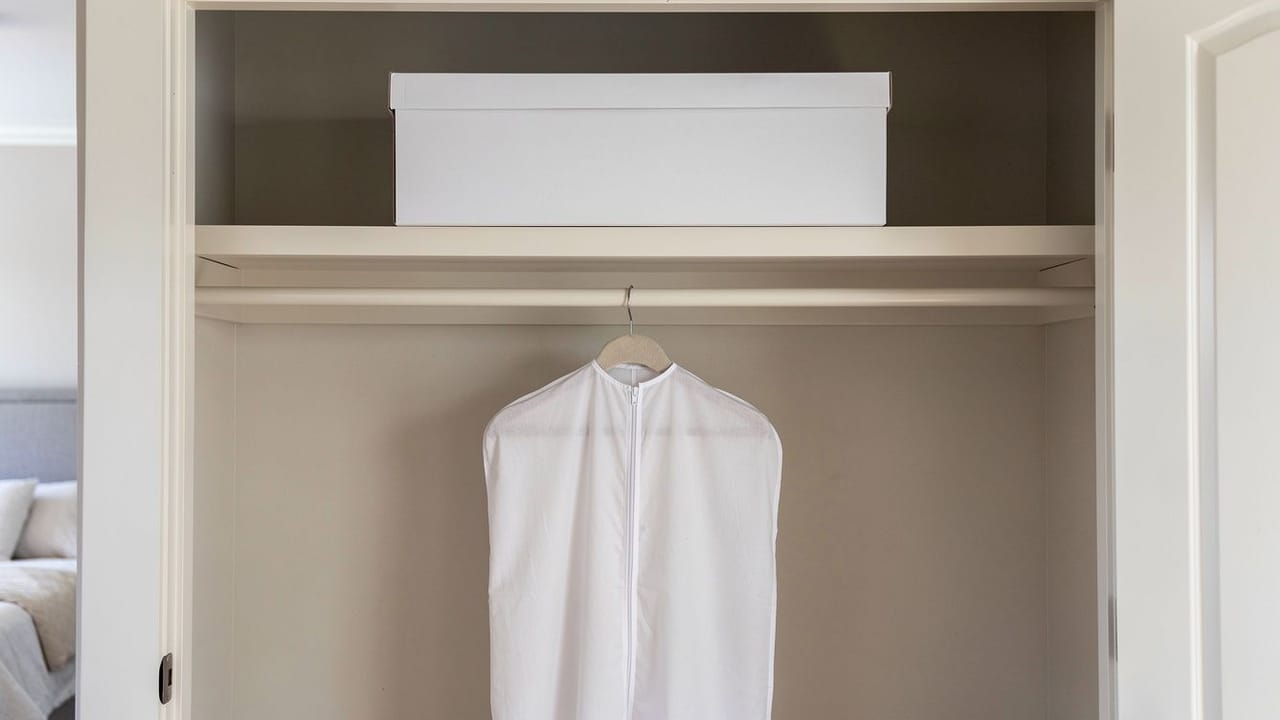
CCI adds advice on covers and spacing. Its basic care guide says not to use plastic garment bags, because no air circulates inside them, and its costume note suggests a dust cover of prewashed cotton sheeting. It also says to hang garments at least 10 cm apart, about four inches. In a closet, that means an heirloom gets its own length of rod rather than a spot squeezed between coats, which is easy to plan into a reach-in closet or a walk-in with a short separate rod.
What should the shelf under a boxed dress be made of?
The shelf under a boxed dress should not be bare wood. CCI’s basic care guide warns that wooden drawers and shelves can give off acidic vapors that yellow fabric and make it brittle, and it names polyethylene plastic and acid-free cardboard boxes as fine for storage. A cedar-lined closet is wood too, so heirlooms there should stay boxed or covered rather than resting on the boards; our post on cedar closets and clothes moths covers what cedar does and does not do.
When a closet is meant to hold a garment box, we size the shelf so the box lies fully supported and flat, with no overhang, and we talk with you about a shelf surface that keeps the box off raw wood. CCI’s environment note also names clothes moth and carpet beetle larvae as especially damaging, so the shelf should sit where the box can be lifted down and checked now and then. We build closets across Nashville and Davidson County and the towns around it. If you want room in one for clothes you plan to keep, ask us for a free estimate.
Sources
- U.S. National Park Service, Conserve O Gram 4/5, Storage Techniques for Hanging Garments: Padded Hangers — Hang only sturdy, structured garments in good condition; store fragile, heavy, embellished, knit or bias-cut garments flat in sized boxes or drawers; polypropylene or acrylic triangular hangers slightly narrower than the shoulders, padded and slipcovered; no wooden hangers, which off-gas acids.
- Canadian Conservation Institute, Basic care: Textiles — Store clean and dry in a cool, dark, dry, ventilated place; avoid folding where possible; no plastic garment bags; wooden drawers or shelves can emit acidic vapors that yellow and embrittle fabric; polyethylene and acid-free cardboard boxes are fine.
- Canadian Conservation Institute, CCI Notes 13/1, Textiles and the Environment — Avoid damp above 70 percent RH, where mold takes about three months; deterioration doubles with each 5°C rise; avoid storage against cold exterior walls; clothes moth and carpet beetle larvae are especially damaging.
- Canadian Conservation Institute, CCI Notes 13/5, Hanging Storage for Costumes — Hang only structurally sound costumes, store fragile, heavily decorated or weak-shouldered ones flat; wooden or plastic hangers padded with batting under a cotton cover; no lightweight wire hangers; cotton dust covers; hang at least 10 cm apart.
FAQ
How to Store a Wedding Dress in a Closet — questions
Is it better to hang or fold a wedding dress?
It depends on the dress. National Park Service conservators hang only sturdy, structured garments in good condition and store fragile, heavy or heavily embellished ones flat in a sized box. Canada’s conservation institute adds bias-cut pieces and anything with weakened shoulder seams to the flat list, and says a textile ideally should not be folded.
Should you store clothes in plastic garment bags?
Not clothes you plan to keep for years. The Canadian Conservation Institute says not to use plastic garment bags for textiles because air does not circulate inside them. It suggests a dust cover of prewashed cotton sheeting instead, which keeps dust off a hanging garment while still letting it breathe.
What humidity is safe for storing vintage clothing?
The firm limit the Canadian Conservation Institute gives is to avoid damp, meaning relative humidity above 70 percent, where mold can develop in about three months. Cooler is better as well: its rule of thumb is that each 5°C of warming doubles the rate of deterioration and halves the textile’s life.
Why do old clothes turn yellow in storage?
One cause the Canadian Conservation Institute names is wood. Its textile care guide warns that wooden drawers and shelves can give off acidic vapors that yellow fabric and make it brittle. That is one reason heirloom clothing is stored in polyethylene or acid-free cardboard boxes rather than directly on wooden shelves.
How far apart should heirloom garments hang?
At least 10 cm, about four inches, according to the Canadian Conservation Institute’s note on hanging storage for costumes. The space keeps garments from crushing and rubbing against each other. In a closet that usually means giving an heirloom its own short rod or a cleared section of a longer one.