
· by Michael Blair, Nashville's Closets
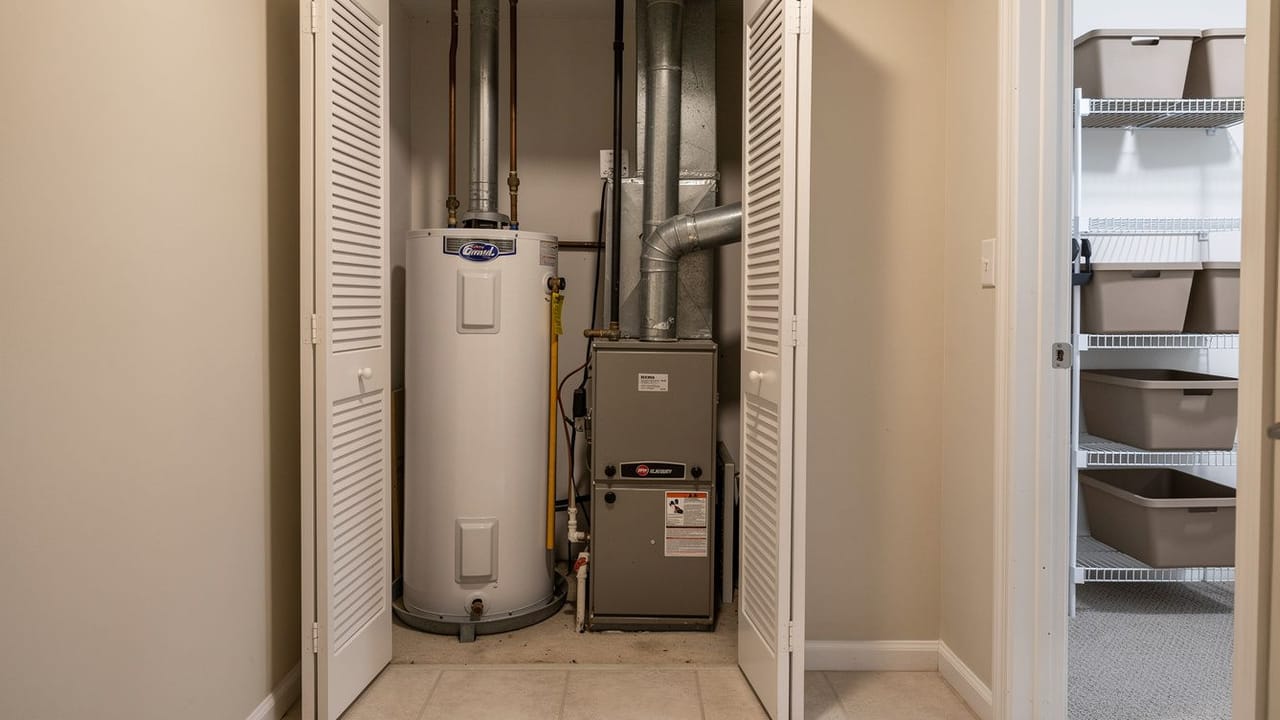
In a lot of Middle Tennessee houses, the water heater and the furnace share a closet off a hallway or the laundry room, behind a louvered door. It looks like the one closet with room to spare, and it fills up: paint cans, the vacuum, holiday bins, a case of water.
When people ask us for laundry and utility storage, this closet is often the one they point at first. The code Nashville enforces and the label on the appliance both say how much of it can be used, and the answer is less than the floor space suggests.
Can you store things in a water heater closet?
Only outside the space the appliance needs, and in most of these closets that leaves very little. Section M1305.1 of the 2024 International Residential Code as adopted by Nashville requires a level working space at least 30 inches deep and 30 inches wide in front of the control side of an appliance, so it can be serviced. Appliances have to be reachable for inspection, repair and replacement without taking out permanent construction.
For an appliance in a closet or alcove, M1305.1.1 adds an opening or door and a clear passage at least 24 inches wide and big enough to remove the largest appliance in the space. A water heater is an appliance under that rule, gas or electric. Bins stacked in front of it are in the space a plumber needs on the day the tank leaks.
Why does a gas furnace closet need open vents?
A gas appliance that takes its combustion air from inside the house needs openings to the rest of the house kept clear. In the same code, section G2407.5.3.1 calls for two permanent openings when indoor spaces are combined to supply that air, one starting within 12 inches of the top of the enclosure and one within 12 inches of the bottom, each with at least 1 square inch of free area per 1,000 Btu per hour of input and never less than 100 square inches.
Those openings are often a grille or a louvered door. Boxes stacked against the lower one cut off the air the burner was sized for. A sealed-combustion, direct-vent furnace that draws its air from outdoors through its own pipe is a different case, because it does not draw on the closet for air.
The code also lists storage closets among the places a fuel-burning appliance may not be installed, apart from exceptions such as direct-vent units, in section G2406.2 of the fuel gas chapter. We read that as one more reason to keep a gas appliance closet for the appliance.
How close can boxes sit to a water heater?
No closer than the clearances on that heater’s label and manual, which vary by model. The owner’s manual for an A.O. Smith residential gas water heater lists 6 inches from the front of the jacket to the closet door, 12 inches above the top, 24 inches in front for servicing, and none at the sides and back. It warns that failing to keep the required clearances to combustible material is a fire hazard.
The same manual says not to install the heater where flammable products will be stored or used unless its burner and pilot sit at least 18 inches above the floor, and that even then the risk of the vapors catching is reduced, not removed. Paint thinner, gasoline for the mower and spray cans belong in a detached shed or a cabinet well away from any burner. The U.S. Fire Administration’s heating safety guidance gives a broader rule of thumb: leave a clear zone of 3 feet or more between any heater and whatever could catch fire.
Where the storage goes instead
Where the storage goes is usually the next closet over. We leave the appliance closet to the appliances and add the shelving, hooks and bins to a hall closet, the laundry wall or the garage, where nothing has a burner or a flue. A reach-in closet refitted with double hanging and shelves often takes everything that was crowding the water heater.
Where a laundry room shares a wall with the water heater, we keep shelving off the service side and outside the label clearances, and we leave any grilles and vents uncovered. The garage takes what is flammable, on garage storage that keeps it off the floor and away from a gas water heater if the garage has one. Our post on the space under the stairs shows another place a house hides room.
We do this work across the area, Murfreesboro included. If a utility closet has become the house’s junk drawer, send us a photo of it and of the closet next to it, and we will tell you what can move where.
Sources
- 2024 International Residential Code as adopted by Nashville, Chapter 13, M1305.1 — The 30-by-30-inch working space and the 24-inch passage to an appliance in a closet or alcove.
- 2024 International Residential Code as adopted by Nashville, Chapter 24, G2406.2 and G2407.5 — Storage closets as a prohibited appliance location, and the size and position of indoor combustion air openings.
- A.O. Smith, residential gas water heater owner’s manual — Closet clearances, the fire-hazard warning and the flammable products rule.
- U.S. Fire Administration, heating fire safety — Keep anything that can burn at least 3 feet from heat sources.
FAQ
Storage in a Water Heater or Furnace Closet — questions
Can I put shelves above my water heater?
Only if the heater’s label allows the room. The A.O. Smith gas model we read asks for 12 inches between the top of its jacket and any material above, and the vent pipe rises through that space. Shelving over a gas water heater crowds both, so we put that storage on another wall or in another closet.
How much space do you need in front of a furnace?
At least 30 inches deep and 30 inches wide of level working space in front of the control side, under section M1305.1 of Nashville’s 2024 residential code. In a closet or alcove, the passage to it must be at least 24 inches wide and large enough to take out the biggest appliance in the space.
Is it safe to keep paint in a furnace closet?
It is a poor place for it. Gas appliance manuals warn against storing flammable products near the burner, and one A.O. Smith manual says raising the burner 18 inches only reduces the chance of vapors igniting. Solvent-based paint, thinners and gasoline belong in a detached shed or cabinet away from any flame.
Does a furnace closet need a louvered door?
Not always. A gas furnace drawing combustion air from inside the house needs two openings, one within 12 inches of the top and one within 12 inches of the bottom, each at least 100 square inches, and a louvered door often provides them. A direct-vent furnace piped to outdoor air does not rely on the closet for air.
Can you store things next to an electric water heater?
Outside its service space, yes, with care. An electric water heater has no flame, but it is still an appliance under the code, so the 30-by-30-inch working space in front of its controls stays clear, along with a 24-inch passage to remove it. The manual may list clearances of its own.