
· by Michael Blair, Nashville's Closets
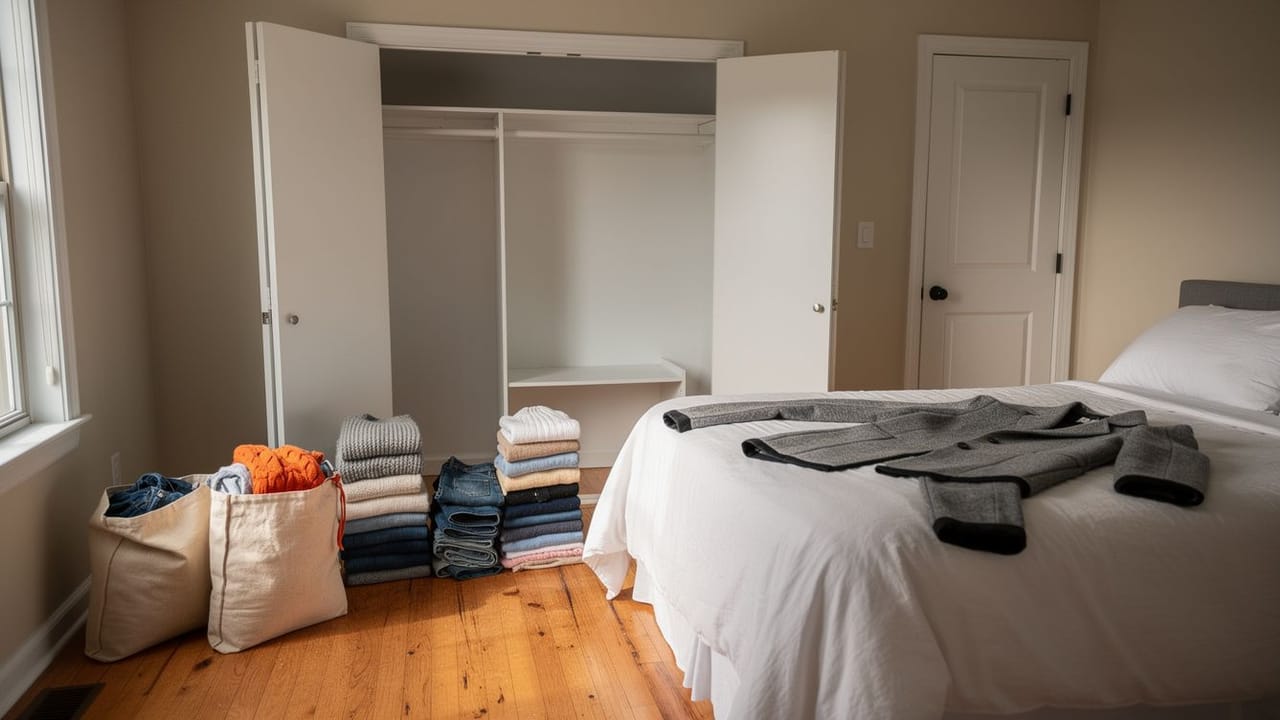
The appealing step is buying the system. The step that decides whether it works is choosing what goes into it, and doing that afterwards means designing storage for things you were about to get rid of. It’s why we would rather measure for a reach-in closet after the clear-out than before it.
Should you declutter before organizing a closet?
Remove everything, decide what stays, then measure what remains. Designing to what you own after a clear-out gives a system sized to reality, and the numbers we design around are in our post on custom closet measurements.
Designing before means paying to store things you may not keep. And the things that leave deserve a better route than the trash: the EPA’s textiles data names discarded clothing as the main source of textiles in municipal solid waste, and counts 11.3 million tons of textiles going to landfills in 2018, when the recycling rate for textiles was 14.7 percent. The bags from a clear-out are worth taking to a donation drop-off or a textile recycler.
Is it better to declutter by category or by room?
We suggest gathering everything of one type from across the house first — all the coats, all the towels — because in our experience it shows duplication that going room by room keeps hidden.
Seeing how many you already have often makes the keep-or-go decision easier.
- Empty the space completely before deciding
- Sort by category across the whole house
- Measure what remains, then design
- Buy containers last, to fit what is left
- Leave real empty space in the finished system
Leave room
A system filled to capacity on day one has nowhere to absorb normal life, and in our experience that’s the one that starts sliding first. Aim to finish with visible empty space.
That is uncomfortable when you have just paid for the storage, and it is what makes it last.
The Middle Tennessee seasonal factor
Our seasons genuinely differ. NOAA’s 1991–2020 climate normals for Nashville International Airport put the average January temperature at 39.6 degrees and the average July temperature at 80.7, so winter coats and summer clothing do not need to compete for prime space year round.
High shelves and under-bed storage suit the off-season clothes, keeping the accessible space for what is actually in use. Wash or dry clean the wool before it goes up there, since UC IPM’s guide to clothes moths notes that insects are less likely to feed on clean fabrics than on heavily soiled ones. Where the boxes should and should not go is covered in our post on storing off-season clothes, and if you’d like a closet drawn up around what is left after the clear-out, ask us for a free estimate.
Sources
- NOAA National Centers for Environmental Information, U.S. Climate Normals 1991–2020, Nashville International Airport (USW00013897) — Monthly normals: January mean 39.6 degrees F, July mean 80.7 degrees F
- U.S. EPA, Textiles: Material-Specific Data — Discarded clothing the main source of textiles in municipal solid waste; 11.3 million tons landfilled and a 14.7 percent textile recycling rate in 2018
- UC IPM (University of California), Pest Notes: Clothes Moths — Insects are less likely to feed on clean fabrics than on heavily soiled ones
FAQ
Why Organizing Before Decluttering Fails — questions
Should I buy storage containers before or after decluttering?
After. Containers bought first get filled with whatever is there, including things you would have discarded, and they are often the wrong size for what actually remains. Sorting first and measuring second means you buy for what you are keeping.
Why do organized spaces get messy again so quickly?
In our experience it is most often because the system was filled to capacity straight away, so there is nowhere for normal life to go, or because it asks for more steps than the habit it replaced. A system that finishes with visible empty space and puts things away in a single step has a better chance of lasting.
Is seasonal rotation worth the effort?
In Middle Tennessee, yes. NOAA’s climate normals for the Nashville airport put the average January temperature about 41 degrees below July’s, so a winter wardrobe and a summer one do not need the same prime space. Keeping only the current season within easy reach cuts what competes for it, high shelves and under-bed storage suit the rest, and the swap itself is a short job.
What is the difference between decluttering and organizing?
Decluttering decides what stays, and organizing gives what stays a place, so the order matters. Storage designed before the clear-out gets sized for things you were about to give away. Gather each category from across the house, keep what you use, measure what is left, and only then design the system and buy the containers.