
· by Michael Blair, Nashville's Closets
In many houses the door from the garage is the one the family uses every day, and behind it there is often a hallway with nothing on the walls. So everything that comes in with people ends up on the kitchen counter. When we plan garage and mudroom storage, we start at that door and work outward, since the first few steps inside are where things get put down.
What belongs in a mudroom drop zone?
Whatever arrives with people needs a home within a few steps of the door: keys, bags, mail, shoes, coats. In our experience, if that home does not exist, it all goes to the nearest flat surface.
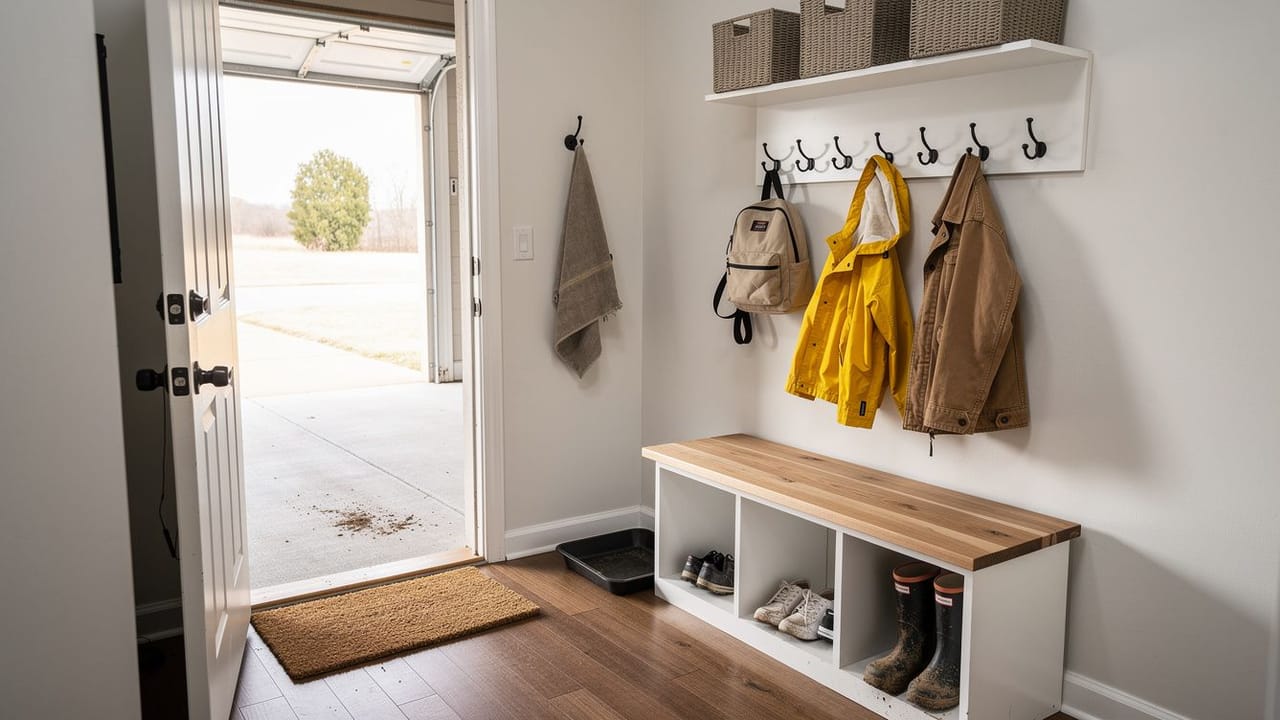
In a hallway with no room for cabinetry, a hook rail, a bench and a shelf cover most of it.
One space per person
We have seen shared bins fill up with everyone’s things and nobody’s responsibility. What keeps a mudroom tidy, in our experience, is a hook and a cubby for each person, because then it is plain whose job it is to clear them.
For coats worn every day we fit hooks rather than hangers, and we set the children’s hooks low. The U.S. Access Board’s 2010 ADA Standards, section 308 on reach ranges, puts a child’s highest forward or side reach at 36 inches for ages 3 and 4, 40 inches for ages 5 through 8 and 44 inches for ages 9 through 12. Those ranges are set for the buildings the ADA covers, not for private homes, but they are a sensible guide to where a child can hang a coat without help. The adult band, and why a shelf above it gets forgotten, is in our post on the measurements a custom closet is designed around.
- A hook and a cubby for each person, not shared bins
- Hooks rather than a rail for daily coats
- A bench to sit on while shoes come off
- Closed storage for shoes if it is visible from the kitchen
- Somewhere for mail and paperwork that is not the kitchen counter
Shoes and the Middle Tennessee reality
Yards, ball fields and job sites all come home on the soles of shoes. The EPA’s page on protecting your family from sources of lead says lead in soil can be tracked into homes on shoes, clothes or other objects, and its advice is a doormat outside and inside every entryway and shoes off before you come in. A place to leave them at the door keeps much of what they carry from going any further into the house.
A boot tray and a bench do more, in our experience, than a purpose-built shoe cabinet you have to bend down to. The same EPA page suggests wiping a pet’s fur and paws after it has been outside, so where there is a dog we leave a hook for its towel by the door. It also advises leaving soiled tools and clothes outside or washing them before they come indoors, which is easier when there is a hook or a shelf for them on the garage side of the door.
What if the entry has no room for a mudroom?
Even a narrow hallway can usually take a hook rail, a slim bench and a shelf above it. We measure the clear width first and size the bench to what is left, and for many households that is enough.
Where even that will not fit, the first cabinet inside the kitchen can become the drop zone, and we would take that over the counter every time. If you would like us to measure your entry and draw it up, ask us for a free estimate.
Sources
- U.S. Environmental Protection Agency, Protect Your Family from Sources of Lead — Lead in soil tracked into homes on shoes and clothes; doormats outside and inside every entryway and shoes off; wipe pets’ fur and paws; leave soiled tools and clothes outside or wash them
- U.S. Access Board, 2010 ADA Standards for Accessible Design, section 308 Reach Ranges — Children’s high forward or side reach of 36, 40 and 44 inches by age group; the standards cover ADA facilities, not private homes
FAQ
Storage for the Way Into the House — questions
How much space does a mudroom need?
Less than people tend to assume. A narrow hallway can usually take a hook rail, a slim bench and a shelf above it, which covers most of what a family drops at the door. What we see go wrong more often is having nothing there at all, rather than having something too small.
Hooks or hangers for coats?
We use hooks for anything worn daily. A hanger takes two hands, and in our experience a coat carried in alongside bags ends up on a chair instead. Hangers belong in a coat closet for things worn now and then. For children, the ADA reach ranges published by the U.S. Access Board put the highest comfortable reach at 36 inches for ages 3 and 4 and 44 inches for ages 9 through 12, which is a fair guide to where their hooks go.
Should shoe storage be open or closed?
In our experience open storage gets used more, because shoes tend to be kicked off rather than put away. Closed storage looks tidier and is worth it if the entry can be seen from the kitchen or the main living area. A bench with open cubbies underneath is a common compromise and a good place to start.
How do you build mudroom storage?
Start at the door and work outward: a hook and a cubby for each person, a bench to sit on while shoes come off, a boot tray, a shelf above and a place for mail that is not the kitchen counter. In a narrow hall we measure the clear width first and size the bench to what remains.