
· by Michael Blair, Nashville's Closets
Most pantries we’re asked to fix have the same problem, and it’s depth. A shelf deeper than you can see across ends up as two zones, the front you use and the back you forget, and buying matching containers doesn’t change that. Depth is the first thing we look at when we plan a pantry or kitchen storage job.
What shelf depth works best in a pantry?
In our experience, twelve to sixteen inches of depth works for most food storage. Go much deeper and the back row disappears behind the front one, and you can’t get to it without unloading what’s in the way.
That back row costs more than space. The University of Kentucky’s entomology fact sheet on pantry pests says an infestation often starts in partly used boxes or bags forgotten at the backs of pantries and shelves, then spreads as the adult insects go looking for new food.
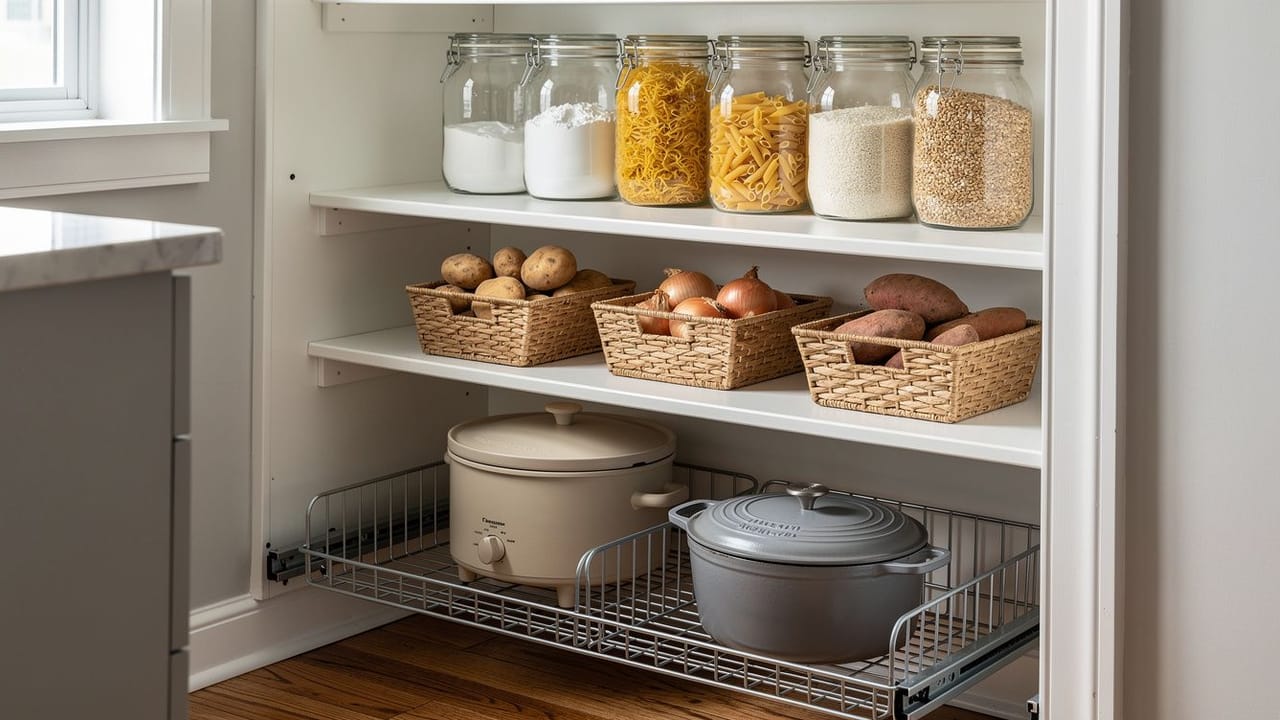
Where a pantry is deep by design, like a corner unit or a walk-in with full-depth shelving, pull-out shelves or baskets bring the back forward. We think they’re worth what they cost there.
Vary the heights
Evenly spaced shelves waste the air above short items. We set closer spacings for cans and jars, one tall shelf for cereal boxes and bottles, and a very tall one at the bottom for small appliances.
Accessibility rules are written for handles and controls rather than shelves, but they make a fair yardstick. The U.S. Access Board’s guide to operable parts puts an unobstructed forward reach between 15 and 48 inches off the floor, and drops the high reach to 44 inches when you’re reaching more than 20 inches over an obstruction. A full front row on a deep upper shelf is that sort of obstruction, so we keep everyday food in the middle band and put the once-a-year things up top.
Adjustable shelving lets the spacing be refined once real food is on it.
- Twelve to sixteen inches deep for most shelving
- Pull-outs or baskets where depth is unavoidable
- Vary shelf spacing to what you store
- Zone by category and keep zones together
- Decant only what benefits from it, into containers that seal
Are zones or matching containers better in a pantry?
Grouping by category (baking, breakfast, cans, snacks) has done more for findability in the pantries we’ve built than matching containers have. A zone tends to survive someone else putting the groceries away; a container system often doesn’t.
We’d label the zone rather than every item, because one shelf label is far more likely to be kept up than forty. Clearing out what you don’t use comes before any of this, which is the subject of our post on why organizing before decluttering fails.
Decanting, honestly
Decanting looks good and helps with things that come in awkward packaging, such as flour, sugar, pasta and cereal. For everything else it adds a step to every grocery run.
The stronger case for decanting dry goods is pests. The University of Kentucky fact sheet names flour and meal among the foods that flour beetles and Indian meal moths feed on, and to keep them from coming back it advises moving products out of cardboard, paper or plastic packaging into jars or other containers that seal tightly.
Anything decanted needs its best-by date and cooking instructions carried over, written on the lid or cut from the bag and taped to the back of the jar. It’s an easy step to skip until you’re standing over a canister of rice with no idea how long it cooks. If you’d like a pantry planned around what you actually keep, ask us for a free estimate.
Sources
- University of Kentucky Entomology, ENTFACT-612 Stored Product Pests in the Pantry — Infestations often start in part-used boxes or bags forgotten at the backs of pantries; flour beetles and Indian meal moths feed on flour and meal; move products into tightly sealed jars or containers to prevent recurring problems
- U.S. Access Board, ADA guide Chapter 3: Operable Parts — Unobstructed forward reach 15 to 48 inches; high reach reduced to 44 inches over an obstruction deeper than 20 inches; applies to operable parts, not shelves
FAQ
A Pantry That Stays Organized for Years — questions
How deep should pantry shelves be?
In our experience twelve to sixteen inches suits most food storage. Deeper shelves create a back row that is hard to see and rarely used, and the University of Kentucky’s entomologists say pantry pest infestations often start in part-used boxes and bags forgotten at the backs of shelves. Where depth is fixed, pull-out shelves or baskets bring the rear forward and recover it.
Is decanting food into containers worth it?
For items in awkward packaging, such as flour, sugar, pasta and cereal, yes, and the University of Kentucky’s pantry pest fact sheet recommends tightly sealed jars or containers to keep pests from coming back. For everything else it adds work at every grocery run. If you do decant, carry over the best-by date and any cooking instructions.
How do I stop the pantry becoming disorganized again?
Zone by category rather than relying on a container system, and label the zone rather than the item. A zone tends to survive someone else unpacking the groceries. In our experience, systems that need every item to go into its own matching jar are the first to slip.
How should canned goods be organized in a pantry?
Give the cans their own zone on a shelf spaced close to their height, so no air is wasted above them, and keep that shelf twelve to sixteen inches deep so the back row stays visible. Label the zone rather than each can. Everyday items belong in the middle band you reach without stretching over a full front row.